Advanced Keyword Mapping: The Enterprise Guide to Topical Authority
Mastering search intent, entity relationships, and strategic content hierarchy to dominate enterprise SERPs in a rapidly evolving digital landscape.
Introduction
lightbulb Key Takeaways
- check_circle Intent over Volume: Prioritizing user intent is non-negotiable for modern enterprise SEO mapping.
- check_circle Entity-Based Clustering: Grouping keywords by semantic relevance builds robust topical authority faster than isolated targeting.
- check_circle Cannibalization Audits: Regular map maintenance prevents internal competition and consolidates ranking signals.
- check_circle Structural Alignment: Your keyword map must directly dictate your site architecture and internal linking strategy.
The days of simple keyword stuffing and isolating search terms based purely on search volume are long gone. In the modern enterprise digital landscape, achieving visibility requires a sophisticated approach to building topical authority. This comprehensive guide details the advanced strategies necessary to construct a keyword map that acts not just as a list of targets, but as the foundational blueprint for your entire SEO and content strategy.
The Evolution of Keyword Research: From Volume to Intent and Entities
Historically, SEO professionals relied heavily on "head terms"—broad keywords with massive search volumes. The strategy was straightforward: find a high-volume keyword, weave it into an article, build links, and hope for the best. This approach is now fundamentally flawed.
Google's algorithms, particularly following updates like Hummingbird, BERT, and MUM, have shifted dramatically towards understanding context, intent, and entities. An entity is a distinct, well-defined thing or concept (e.g., a person, place, or abstract idea like "Technical SEO"). Modern keyword research must focus on how these entities relate to one another within a broader topic graph.
The Anatomy of an Advanced Keyword Map
An enterprise-grade keyword map is a complex data structure. It is typically managed in robust spreadsheet software or dedicated SEO platforms and must include specific data points beyond just the keyword itself. Essential columns include:
- Primary Keyword: The core entity or topic.
- Secondary/Supporting Keywords: Semantic variations and long-tail terms.
- Search Intent Classification: (Navigational, Informational, Commercial, Transactional).
- Target URL: The specific page designed to rank for this cluster.
- SERP Features: Opportunities present (Featured Snippets, People Also Ask, Knowledge Panels).
- Priority/Business Value: A metric indicating the potential ROI of ranking for the term.
Search Intent Mastery
Classifying intent at scale is perhaps the most critical step in keyword mapping. If your content format doesn't match the user's implicit intent, you will not rank, regardless of the quality of your Web Design or the strength of your backlink profile.
- Informational: The user is seeking knowledge (e.g., "how to improve site speed"). Target these with comprehensive blog posts, guides, or pillar pages.
- Navigational: The user is looking for a specific page (e.g., "PC Web Design login").
- Commercial Investigation: The user is comparing options (e.g., "best enterprise SEO platforms"). Target these with comparison pages, reviews, or detailed feature breakdowns.
- Transactional: The user is ready to act (e.g., "buy managed WordPress hosting"). Target these with optimized product or service pages.
Keyword Clustering & Topical Relationships
Keyword clustering involves grouping related search queries into semantic themes. Instead of creating ten different pages for "SEO audit guide," "how to do an SEO audit," and "SEO audit steps," you consolidate these into one authoritative asset.
This approach builds topical authority. When search engines recognize that your domain covers a subject exhaustively across multiple interconnected clusters, your overall rankings for that entire semantic field improve. Statistics indicate that a clustered content strategy can lead to a significant increase in organic traffic for long-tail variations.
The Power of the Long-Tail
Industry benchmarks suggest that up to 70% of long-tail traffic is captured more effectively when content is structured in comprehensive, intent-driven clusters rather than isolated, single-keyword targeting.
URL Mapping & Content Hierarchy
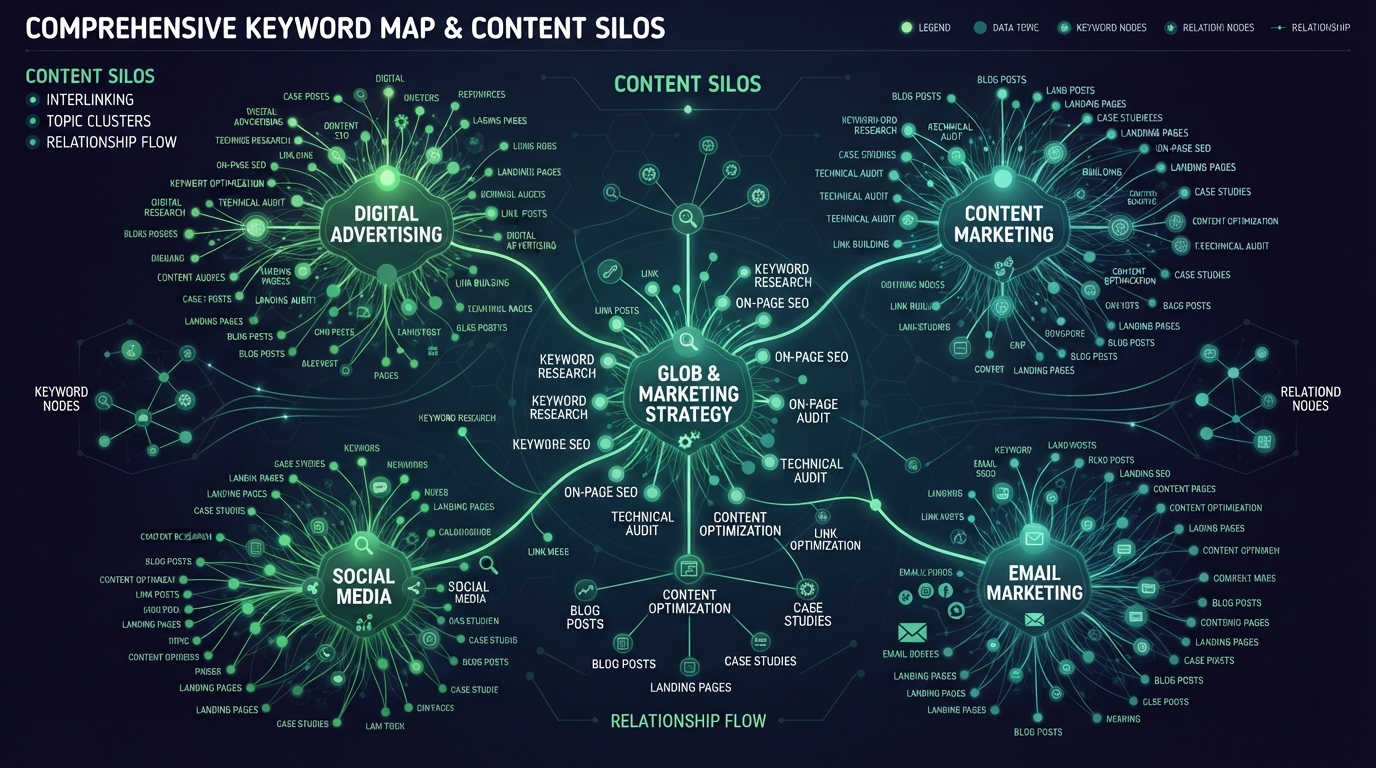
Your keyword map must translate directly into site architecture. The standard model for establishing topical authority is the Pillar-Cluster model.
- Pillar Pages: Broad, comprehensive overviews of a core topic (e.g., "The Ultimate Guide to Technical SEO").
- Cluster Content: Deep dives into specific subtopics related to the pillar (e.g., "Core Web Vitals Optimization," "XML Sitemap Best Practices").
- Supporting Assets: Case studies, FAQs, or localized content that support the cluster.
The keyword map dictates exactly which keyword variations belong on the pillar page versus the specific cluster pages.
Identifying & Resolving Keyword Cannibalization
Keyword cannibalization occurs when multiple pages on your domain compete for the same search query, diluting your ranking signals and confusing search engines. A well-maintained keyword map is your primary defense against this.
If you identify overlap during an audit, consolidation strategies are required. This often involves merging competing pages into one authoritative resource and implementing 301 redirects to preserve link equity.
Content Gap Analysis
A keyword map isn't just about organizing what you have; it's about discovering what you're missing. By analyzing the SERP footprints of your top competitors, you can identify "content gaps"—lucrative semantic clusters where your domain lacks visibility.