E-commerce Conversion Secrets: A Technical Deep-Dive
Introduction
lightbulb Key Takeaways
- check_circle Performance is paramount: Every 100ms delay costs up to 1% in sales. Site speed optimization requires technical rigor, not just image compression.
- check_circle Trust signaling must be contextual: Generic badges fail. Integrate dynamic trust signals directly adjacent to friction points (add-to-cart, checkout).
- check_circle Mobile UX isn't just responsive: It requires distinct interaction paradigms, particularly regarding thumb zones and simplified checkout flows.
In the highly competitive landscape of digital commerce, driving traffic is only half the battle. The true measure of a platform's efficacy lies in its ability to convert that traffic into revenue. While surface-level tweaks like button color changes are often touted as quick fixes, substantial, sustainable growth demands a deeply technical and strategic approach to conversion rate optimization (CRO).
This comprehensive analysis explores the granular mechanics of e-commerce conversion. We bypass superficial advice to examine the structural, psychological, and performance-based elements that dictate user behavior and drive quantifiable sales metrics.
Site Speed and Technical Performance (Core Web Vitals)
Before optimizing individual components, the underlying architecture must be sound. The structural integrity of an e-commerce platform directly dictates its capacity for speed, scalability, and seamless user experiences. Modern front-end architectures such as JAMstack and server-side rendering (SSR) frameworks like Next.js and Nuxt.js have revolutionized how quickly content can be delivered to the end-user.
The Latency Penalty
The correlation between site speed and conversion rates is heavily documented, yet persistently underestimated. According to recent benchmarks, e-commerce sites loading within 1-2 seconds see conversion rates significantly higher than those lagging behind. The architecture driving this speed is critical. Every subsequent second of delay is a measurable leak in the sales funnel.
Industry Benchmark
speedof consumers admit that page speed impacts their willingness to buy from an online retailer.
Achieving sub-second load times requires more than basic caching. It involves advanced techniques such as edge computing delivery, aggressive code splitting, and strategic resource prioritization. In professional Shopify Development, minimizing the reliance on client-side rendering for critical path elements and optimizing Liquid template efficiency are paramount. We frequently deploy headless architectures or heavily optimize monolithic structures to ensure maximum rendering speed, minimizing the Time to Interactive (TTI).
Focus heavily on Google's Core Web Vitals: Largest Contentful Paint (LCP), First Input Delay (FID), and Cumulative Layout Shift (CLS). Optimizing LCP requires preloading key hero images or text, ensuring server response times are minimized (TTFB), and eliminating render-blocking resources. CLS optimization ensures that as images load dynamically, the layout doesn't inexplicably jump, preventing accidental clicks on unintended links or buttons.
Product Page Engineering (Visuals, Hierarchy, Psychology)
The Product Detail Page (PDP) is the nexus of decision-making. Optimizing the PDP requires balancing emotional resonance with factual clarity and frictionless interaction. The hierarchy of information must lead the user seamlessly from initial impression to logical confirmation and ultimately to action.
The Visual Hierarchy
Users rarely read PDPs top-to-bottom; they scan. The visual hierarchy must cater to this behavior. Key elements—product title, price, key features, and the Add to Cart (ATC) button—must be immediately visible without scrolling (above the fold). The strategic use of negative space is as important as the content itself; overcrowding the initial viewport creates cognitive overload and decision paralysis.
Psychologically, humans are hardwired to process visual information exponentially faster than text. High-quality imagery establishes immediate trust. The layout should guide the eye from the hero image across to the product title, down through the social proof (star ratings), to the price, and terminating at the primary call-to-action. Any element that disrupts this flow is friction.
Professional Product Photography and Media
In a digital environment, the screen is the only medium through which the user can experience the product. Therefore, media quality directly correlates with perceived product quality. Standard, well-lit white background images are necessary, but insufficient for maximum conversion.
Employ a diverse media mix: contextual lifestyle shots that show the product in use, extreme close-ups detailing texture and build quality, and 360-degree interactive models or short looping videos demonstrating functionality. Video content alone has been shown to increase conversion probability by up to 80% when executed correctly. Furthermore, implementing AR (Augmented Reality) capabilities for products where scale or context is critical (e.g., furniture, eyewear) bridges the physical-digital gap remarkably well.
Strategic Pricing and Dynamic Incentives
Price presentation significantly impacts perception. The psychology of pricing goes far beyond ending a number with .99. The way discounts are displayed, the framing of shipping costs, and the timing of incentives are powerful levers.
When displaying discounts, utilize the "Rule of 100": for items under $100, display the percentage discount; for items over $100, display the absolute dollar amount saved. This maximizes the perceived value of the offer. Dynamic incentives, such as progress bars towards free shipping or tiered volume discounts appearing right when a user adds an item to their cart, capitalize on momentum and significantly increase Average Order Value (AOV).
UX and Information Architecture
A beautiful site is useless if users cannot find what they are looking for. Information Architecture (IA) is the structural foundation of usability. The taxonomy of categories, the granularity of filtering systems, and the efficacy of internal search dictate how efficiently a user can navigate.
Faceted Navigation and Search
For catalogs exceeding a few dozen items, robust faceted search is non-negotiable. Filters must be highly relevant to the category (e.g., filtering laptops by RAM, not just brand). Search functionality must handle typos, synonyms, and natural language queries, ideally auto-suggesting products visually in a dropdown menu as the user types. An intuitive mega-menu structure helps categorize vast inventories without overwhelming the user with a wall of links.
Mobile-First Shopping Paradigms
Responsive design is no longer an innovation; it is a baseline requirement. True mobile-first optimization requires rethinking interaction models specifically for touch interfaces and smaller viewports. Over 60% of digital commerce traffic now originates on mobile devices, yet conversion rates often lag behind desktop.
Design for the "Thumb Zone." Critical interactive elements, especially primary CTAs and navigation controls, should reside in the easily reachable lower half of the screen. Utilize sticky add-to-cart bars that persist as the user scrolls through lengthy product descriptions. Streamline data entry by leveraging mobile native capabilities like camera-based credit card scanning and digital wallets (Apple Pay, Google Pay) to bypass tedious manual input.
Global and Local Trust Signals
Anxiety is the primary enemy of conversion. Trust signals mitigate this anxiety by providing conscious and subconscious reassurances. However, a generic "100% Secure" badge in the footer is often ignored as wallpaper.
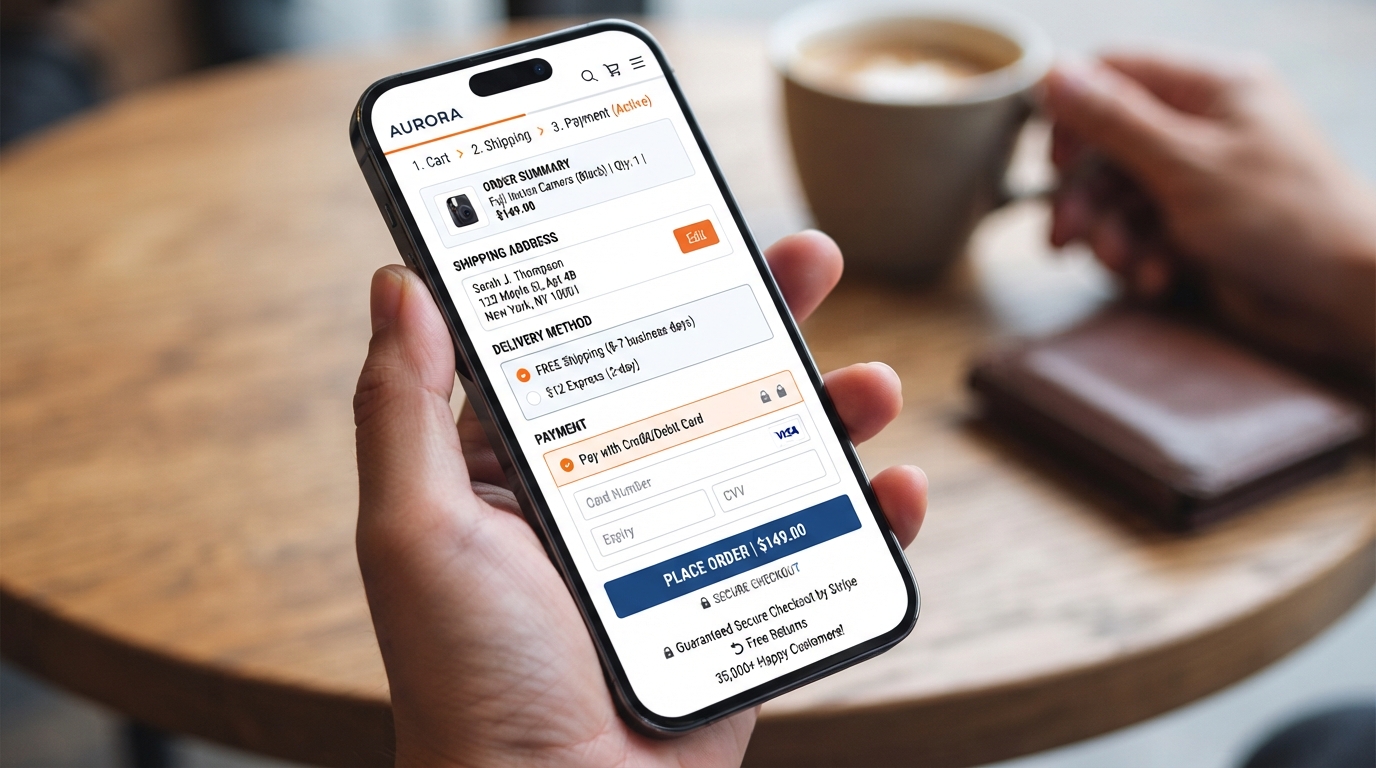
Trust signals must be contextual and injected at friction points. Global trust signals include professional design, fast loading times, and transparent 'About Us' pages. Local trust signals include displaying secure checkout lock icons immediately adjacent to the credit card input field, clearly stated return policies near the 'Add to Cart' button, and recognized payment logos. Establishing authority through third-party endorsements or certifications relevant to your industry significantly boosts credibility.
CTA Optimization and Button Psychology
The Call-to-Action (CTA) button is the ultimate focal point of any e-commerce page. Its design, placement, and copy significantly impact click-through rates. The button must command attention visually without appearing incongruent with the overall design system.
Color, Contrast, and Copy
While there is no universally "best" color for a CTA, high contrast relative to the surrounding elements is essential. The CTA should pop out against the background. Equally important is the microcopy. Instead of generic phrases like "Submit" or "Buy Now," test action-oriented and value-driven copy like "Add to My Bag" or "Get Instant Access." The button must look clickable, utilizing subtle hover states, shadows, or micro-animations to provide satisfying interactive feedback.
Reducing Checkout Friction
The checkout flow is where the highest intent users are most likely to abandon their journey. Every unnecessary step, form field, or visual distraction increases the probability of abandonment. The goal is to create an almost frictionless tunnel to completion.
Implement guest checkout prominently; forcing account creation is a leading cause of cart abandonment. Minimize form fields by utilizing inline validation (informing the user of errors as they type, not after submission), address auto-completion APIs (like Google Places), and automatically matching billing to shipping addresses by default. A progress indicator (e.g., Step 2 of 3) sets clear expectations and reduces anxiety regarding the length of the process. Isolate the checkout visually by removing standard header navigation, forcing focus solely on task completion.
Cart Abandonment Recovery Frameworks
Despite best efforts, cart abandonment will occur. A robust recovery framework is necessary to recapture this lost revenue. This typically involves a multi-tiered approach utilizing email and SMS remarketing.
The timing and messaging of recovery sequences are critical. An initial email sent within 1-2 hours should act as a helpful reminder, addressing potential technical issues or answering common FAQs. A subsequent email 24 hours later might introduce a subtle urgency or a small incentive (like free shipping) to nudge the user across the line. These emails must feature large, clear images of the abandoned items and a single-click link that reconstructs their cart instantly.
Personalization and Predictive Shopping
Treating all users identically leaves immense value on the table. Personalization engines utilize behavioral data, purchase history, and demographic information to dynamically alter the shopping experience, presenting highly relevant products and messaging.
Predictive algorithms can drive powerful "Frequently Bought Together" or "Customers Who Bought This Also Bought" modules, significantly boosting AOV. Personalization extends to dynamic landing pages that adapt based on the traffic source (e.g., showing different hero messaging to a user arriving via an Instagram ad versus an organic search). While implementing advanced ML-driven personalization requires technical investment, the return on providing a curated, tailored experience is substantial.
A/B Testing and Growth Experimentation
Conversion rate optimization is fundamentally an empirical discipline. Intuition must be subservient to data. Continuous A/B testing and multivariate testing form the backbone of sustained growth.
Establish a rigorous testing culture. Do not test random elements; base hypotheses on quantitative data (analytics, heatmaps) and qualitative feedback (user surveys, session recordings). Test significant changes first—entirely different page layouts, entirely different pricing structures, or radically different value propositions—before moving to granular adjustments like button radii or minor copy tweaks. Ensure statistical significance is reached before declaring a winner to avoid false positives.
Post-Purchase Experience and Lifetime Value (LTV)
Conversion optimization does not end at the transaction. The post-purchase experience dictates customer retention, and acquiring a new customer is significantly more expensive than retaining an existing one. Maximizing Customer Lifetime Value (LTV) is the ultimate metric of e-commerce success.
Transform transactional emails (order confirmations, shipping updates) into marketing opportunities by including complementary product recommendations or loyalty program invitations. Provide exceptional unboxing experiences that encourage social sharing. Implement robust loyalty and referral programs that incentivize repeat purchases and turn satisfied customers into active brand advocates. A frictionless return process, contrary to intuition, actually increases long-term loyalty by demonstrating trust and prioritizing customer satisfaction.
In conclusion, mastering e-commerce conversion is an ongoing process of architectural refinement, psychological alignment, and rigorous experimentation. By addressing these foundational elements with precision and technical expertise, businesses can build sustainable growth engines capable of dominating their respective markets.
Social Proof and Advanced Review Systems
Consumer reliance on peer validation is profound. Basic star ratings are helpful, but advanced review systems drive substantially more engagement. Implement review platforms that allow customers to upload their own photos and videos of the product, providing unfiltered reality that heavily influences hesitant buyers.
Allow prospective buyers to filter reviews by relevant demographic or product attributes (e.g., filtering clothing reviews by the reviewer's height and weight). Highlighting "Top Critical Reviews" alongside "Top Positive Reviews" demonstrates transparency and authenticity; consumers are often suspicious of products with only 5-star ratings. Furthermore, user-generated content (UGC) sourced from social media platforms integrated directly into the PDP serves as incredibly potent social proof.