WordPress vs. Shopify: The Ultimate Enterprise Edition
An in-depth, enterprise-grade analysis of cost, ownership, customization, and long-term scalability to help you choose the ultimate platform for digital growth.
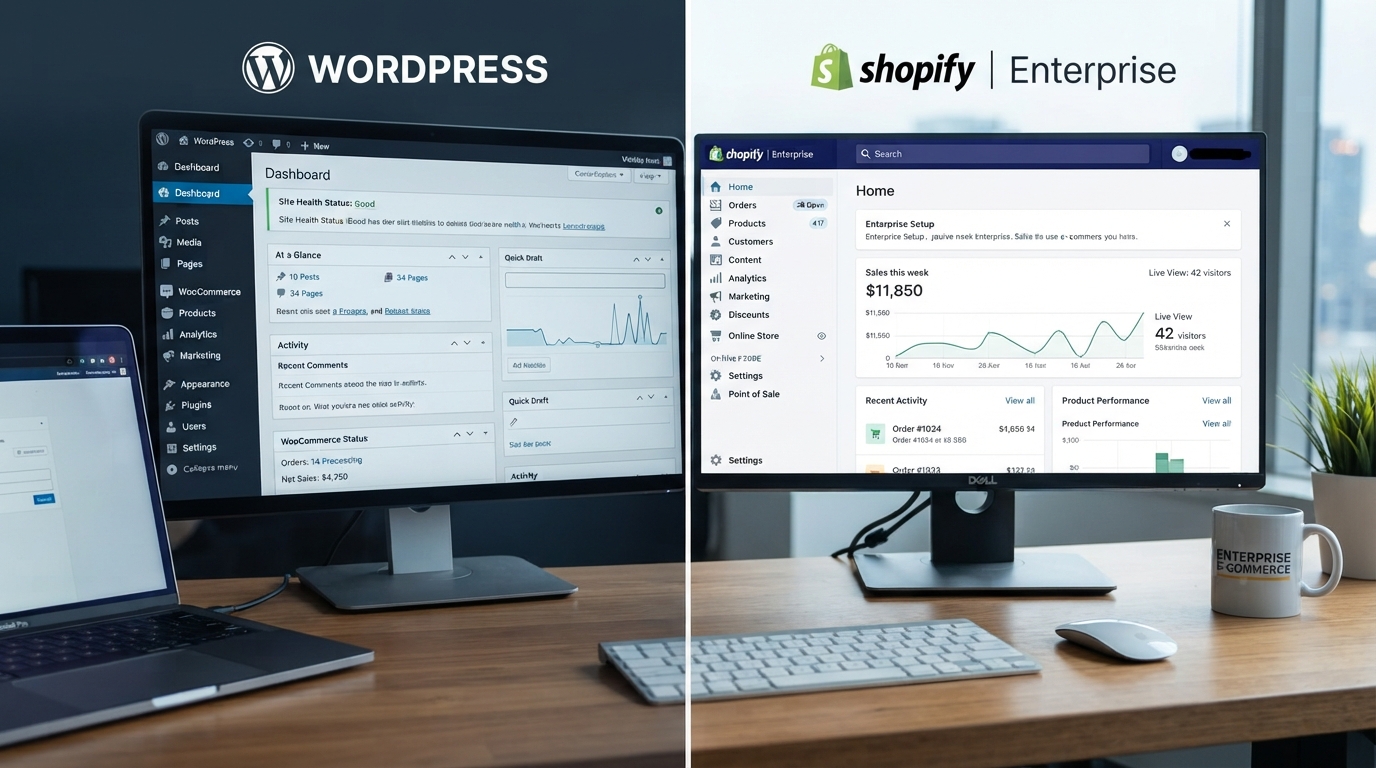
Introduction (Enterprise Context)
In the modern corporate landscape, selecting the foundational architecture for your digital commerce strategy is a critical decision. The debate between WordPress (coupled with WooCommerce) and Shopify represents a fundamental choice between absolute ownership and streamlined management. This is not merely a technical choice; it is a strategic business decision that dictates how a company scales, adapts to market changes, and manages its capital over the next decade.
Enterprise-level e-commerce operations deal with complexities far beyond the scope of a standard retail outlet. From managing millions of SKUs, complex B2B pricing structures, and multi-region tax compliance, to executing high-velocity flash sales and maintaining rigorous data security protocols, the demands are immense. The chosen platform must not only handle current volume but possess the architectural headroom to accommodate explosive growth and pivot alongside evolving consumer behaviors.
This comprehensive analysis dissects both platforms through the lens of enterprise scalability, evaluating them not just as tools, but as steadfast partners in digital growth. We will explore how their differing philosophies on customization, cost structure, and technical overhead impact long-term strategic viability. For the CTO, CIO, and Director of E-commerce, understanding these foundational differences is paramount to building a resilient, future-proof digital ecosystem.
Ultimately, the decision hinges on identifying which platform aligns best with your organization's internal technical capabilities, risk tolerance, and growth trajectory. A misstep here can lead to years of technical debt, stifled innovation, and compromised market position. Therefore, we present an exhaustive, pillar-by-pillar examination to illuminate the path forward.
lightbulb Key Takeaways
- check_circle WordPress offers unparalleled customization and data ownership, ideal for complex, unique business models needing deep architectural control.
- check_circle Shopify provides a robust, managed infrastructure that accelerates time-to-market and minimizes technical maintenance overhead.
- check_circle Total Cost of Ownership (TCO) scales differently: Shopify's predictability vs. WordPress's variability based on development needs.
Cost Analysis & TCO
When evaluating enterprise commerce platforms, Total Cost of Ownership (TCO) extends far beyond initial licensing fees. It encompasses development, maintenance, third-party integrations, and operational scaling costs. An accurate TCO model must project out three to five years, factoring in not just fixed costs, but the variable costs associated with growth, transaction volumes, and inevitable technical pivots.
The Shopify TCO Model (SaaS Predictability)
Shopify operates on a Software as a Service (SaaS) model. The base subscription costs are transparent, but enterprise-level solutions typically require Shopify Plus, starting around $2,000 per month or a percentage of revenue (typically 0.25% once revenue exceeds $800,000/month). This model provides cost predictability for standard operations. You are paying for server infrastructure, security, maintenance, and baseline functionality bundled into a single recurring fee.
However, the true TCO of Shopify Plus often balloons when extending functionality. The reliance on the Shopify App Store means enterprise users often stack dozens of third-party applications, each carrying its own monthly subscription. Furthermore, transaction fees (if not using Shopify Payments) and the cost of specialized Liquid developers for bespoke frontend work add significant layers to the ongoing operational expenditure. While initial build costs might be lower, the recurring revenue-share model can become a substantial line item as your Gross Merchandise Value (GMV) scales into the tens of millions.
The WordPress TCO Model (Open-Source Variability)
WordPress, fundamentally open-source, presents a different cost paradigm. The core software is free, but enterprise deployments necessitate robust managed hosting (like Kinsta, WP Engine, or enterprise AWS setups), premium plugins, and often, retained development teams. The initial capital expenditure (CapEx) can be significantly higher for a tailored build. You are paying to construct the architecture from the ground up, ensuring every component aligns perfectly with your business logic.
The long-term operational expenditure (OpEx), however, may scale more efficiently for complex business models. You are not penalized with revenue-share fees as you grow. If your GMV jumps from $10M to $50M, your hosting costs will increase, but not proportionally to your revenue in the way a SaaS model might dictate. The hidden costs in the WordPress model lie in maintenance: security patching, plugin updates, and general technical stewardship require dedicated resources, either internal or via an agency retainer.
Flexibility & Customization
Enterprise agility often relies on the ability to rapidly adapt digital experiences. Customization capabilities define the boundaries of this adaptability. In a landscape where unique customer experiences are a primary differentiator, platform rigidity is a significant liability.
With WordPress and WooCommerce, absolute architectural freedom is the defining characteristic. Because you possess full access to the source code and database, every component—from the database schema to the rendering layer—can be modified. This level of access allows businesses to construct highly specific workflows, such as multi-tiered B2B pricing algorithms, bespoke product configuration engines, or complex integration layers with legacy ERP systems. If a feature doesn't exist, your development team can build it. There are no artificial barriers imposed by a vendor.
Conversely, Shopify relies on proprietary APIs and Liquid templating. While incredibly powerful for standard e-commerce operations, deep systemic modifications often hit hard limits. Shopify's core checkout, for example, was notoriously locked down until the recent introduction of Checkout Extensibility, and even then, modifications must operate within strict API parameters. When business logic requires stepping outside these boundaries, enterprises are often forced into complex workarounds, middleware layers, or migrating to a headless Shopify architecture, which introduces significant architectural complexity and development overhead. Shopify trades absolute flexibility for stability and ease of deployment.
Hosting & Infrastructure
The underlying infrastructure powering an enterprise e-commerce platform dictates its reliability, speed, and capacity to handle traffic spikes. Shopify operates as a fully managed SaaS solution. This means Shopify handles all server provisioning, load balancing, bandwidth scaling, and uptime monitoring. For the enterprise, this is a massive offloading of responsibility. Shopify's infrastructure is globally distributed and designed to handle massive concurrent traffic, such as during Black Friday cyber sales. The trade-off is a lack of granular control over server environments.
WordPress requires self-hosting or managed hosting. While this introduces the burden of infrastructure management, it also provides total control. Enterprises can design bespoke cloud architectures on AWS, Google Cloud, or Azure, optimizing server geography, database clustering, and caching layers specifically for their unique traffic patterns. This self-hosted model allows for customized disaster recovery protocols and private network integrations, which are often requirements for strict corporate IT governance.
Security & Compliance
Security is paramount in enterprise e-commerce, where breaches can result in millions of dollars in damages and severe reputational harm. Shopify shines in this arena due to its closed ecosystem. It is Level 1 PCI DSS compliant out of the box. Shopify manages all security patches, DDOS protection, and network-level security. Enterprises benefit from a fortified perimeter maintained by a dedicated security team, significantly reducing risk and compliance overhead.
WordPress security operates on a shared responsibility model. While the core software is secure, vulnerabilities are frequently introduced through third-party plugins or poor server configurations. Achieving PCI compliance on a self-hosted WooCommerce setup requires significant investment in Web Application Firewalls (WAFs), regular penetration testing, strict access controls, and continuous monitoring. For enterprises with rigorous infosec teams, this allows for the implementation of custom security protocols, but it demands constant vigilance.
Performance & Speed
In e-commerce, milliseconds translate directly to revenue. A delay in page load time can precipitously drop conversion rates. When assessing platform performance, it's essential to look beyond raw server speed and understand how each architecture handles complex queries, large product catalogs, and concurrent user sessions.
Shopify's globally distributed Content Delivery Network (CDN) and optimized server architecture generally guarantee rapid page loads for standard implementations. The platform is engineered specifically for e-commerce, ensuring that database queries for products, inventory, and checkout processes are highly performant. However, performance degradation can occur if an excessive number of unoptimized third-party applications are installed, as these often inject external scripts that block rendering. Shopify's rigid backend prevents users from inadvertently breaking core performance, providing a consistently fast, albeit managed, baseline.
Performance optimization on WordPress is an entirely different beast. Out of the box, a standard WordPress and WooCommerce installation is not tuned for enterprise scale. It requires rigorous optimization. This involves implementing robust caching mechanisms (object caching, page caching, opcode caching), configuring a high-performance CDN, and continuously profiling database queries. If executed correctly by experienced systems administrators and developers, a customized WordPress stack can be staggeringly fast, specifically tailored to the unique data architecture of the business. However, poor server configuration, bloated themes, or poorly coded plugins can cripple performance, leading to slow query times and server timeouts during high-traffic events. The ceiling for performance is higher on WordPress, but it requires significant technical expertise to reach and maintain it.
SEO & Content Mgmt
Organic search visibility is a cornerstone of sustainable e-commerce growth. The platform you choose profoundly impacts your ability to structure data, optimize technical SEO elements, and execute comprehensive content marketing strategies.
WordPress, fundamentally designed as a Content Management System (CMS), excels in this category. Its architecture allows for deep, granular control over every aspect of on-page SEO. From custom permalink structures and rich snippet integration to advanced semantic HTML markup and robust blogging capabilities, WordPress offers unparalleled flexibility. When paired with plugins like Yoast or RankMath, enterprise marketing teams can execute complex content strategies, managing thousands of landing pages, blog posts, and specialized resource hubs with ease. The open nature of the platform means that if Google introduces a new schema or ranking factor, the WordPress ecosystem adapts almost instantly, allowing businesses to stay ahead of the curve.
Shopify, conversely, approaches SEO primarily through the lens of standard e-commerce functionality. While it provides essential tools for modifying title tags, meta descriptions, and image alt text, it presents significant limitations for advanced technical SEO. A notorious sticking point is the rigid URL structure—Shopify enforces subdirectories like `/products/` and `/collections/`, which cannot be entirely customized. Furthermore, its built-in blogging engine is rudimentary compared to WordPress, making it challenging to execute ambitious, content-led acquisition strategies without relying on external solutions or headless architectures. While perfectly adequate for pure-play retail focusing on product-level SEO, businesses heavily reliant on editorial content or complex site architectures often find Shopify's native capabilities restrictive.
E-commerce Functionality
Core e-commerce functionality encompasses the essential mechanisms of selling: product catalog management, cart logic, pricing rules, inventory tracking, and the checkout process. For enterprise operations, these mechanisms must be robust, reliable, and capable of handling significant complexity.
Shopify delivers a world-class, streamlined e-commerce engine out of the box. Its intuitive interface for managing products, variants, and collections is arguably the industry standard. The platform is engineered to facilitate sales efficiently, with features like multi-channel selling, automated abandoned cart recovery, and integrated payment processing (Shopify Payments) available natively or via simple setup. Shopify Plus further enhances this with tools like Shopify Scripts for custom pricing logic and Launchpad for automated sales events. The checkout experience, while historically rigid, is highly optimized for conversion and reliability, providing a seamless transaction flow that consumers inherently trust.
WordPress, via the WooCommerce plugin, transforms a CMS into a potent e-commerce platform. While the core WooCommerce plugin provides foundational selling tools, true enterprise functionality requires extensive configuration and supplementary plugins. This modularity is both a strength and a weakness. It allows businesses to build highly customized selling environments—such as intricate subscription models, composite products, or dynamic B2B wholesale pricing—that might be impossible on Shopify without a headless setup. However, this flexibility demands a higher degree of technical oversight. Managing a complex WooCommerce instance involves ensuring compatibility between numerous extensions handling different aspects of the e-commerce lifecycle, from complex shipping calculation rules to specialized tax compliance engines. It is a powerful engine, but it requires skilled mechanics to run smoothly.
Integrations & Apps
An enterprise e-commerce platform rarely operates in isolation; it must seamlessly integrate with a broader tech stack, including ERP systems (like NetSuite or SAP), CRM platforms (like Salesforce), marketing automation tools, and specialized logistics providers. The integration capabilities of a platform are therefore critical to operational efficiency.
Shopify boasts a massive, highly curated App Store. For many standard integrations, a well-supported app exists, allowing for rapid deployment of new functionalities like reviews, loyalty programs, or standard ERP connectors. Furthermore, Shopify provides robust REST and GraphQL APIs, enabling custom integrations when off-the-shelf solutions fall short. However, reliance on the App Store introduces complexities for enterprises. Stacking multiple third-party apps can lead to code bloat, performance issues, and complex dependencies. Crucially, enterprise data often must pass through these third-party servers, introducing potential security and compliance vectors that must be carefully managed.
WordPress relies on an enormous ecosystem of plugins and its open REST API. Because developers have access to the underlying database and core logic, custom integrations can be built natively, directly connecting WordPress data structures to external systems without relying on middle-tier software. This allows for incredibly tight, specialized integrations with legacy enterprise systems that lack modern API endpoints. While there are thousands of plugins available, the quality and security of these vary wildly compared to Shopify's vetted App Store. Enterprises utilizing WordPress must implement strict governance over plugin usage, often opting to build bespoke integrations rather than relying on third-party code to ensure stability, security, and optimal performance within their specific architectural framework.
Themes & UX Design
The presentation layer—the User Experience (UX) and User Interface (UI)—is the digital storefront. For enterprise brands, maintaining a distinct, high-performance, and cohesive brand identity across all touchpoints is non-negotiable. The chosen platform must facilitate exceptional design without compromising functionality.
Shopify utilizes a proprietary templating language called Liquid. It offers a robust selection of professionally designed, mobile-responsive themes that provide a solid foundation for e-commerce. For enterprises, these themes are typically heavily customized or abandoned entirely in favor of fully bespoke theme development. Liquid is powerful and relatively easy for frontend developers to grasp, allowing for the creation of sophisticated, dynamic user interfaces. However, developers are still operating within the constraints of the Shopify ecosystem. While the introduction of Online Store 2.0 provided more modularity via JSON templates, deeply complex, non-standard layout architectures can sometimes require creative engineering to execute efficiently within the Liquid framework.
WordPress offers unparalleled freedom in UI/UX design. It is completely decoupled from any specific templating language, allowing frontend teams to utilize PHP, React, Vue.js, or any modern framework to render the user experience. Businesses can build entirely bespoke, pixel-perfect themes from the ground up, ensuring absolute adherence to brand guidelines. This flexibility is particularly advantageous for brands requiring complex, interactive product configurators, immersive storytelling elements seamlessly integrated with commerce, or entirely unique navigational structures. Furthermore, the advent of full-site editing and headless WordPress architectures means that the backend CMS can drive virtually any frontend experience imaginable, constrained only by the imagination and capability of the design and development teams.
Development Requirements
The internal capability and structural makeup of your engineering teams will heavily influence the success of either platform choice. The technical prerequisites for building, maintaining, and scaling on these platforms differ significantly, impacting hiring, training, and operational workflows.
Developing on Shopify generally requires less deep infrastructural knowledge. Teams need proficiency in HTML, CSS, JavaScript, and specifically, Shopify's Liquid templating language. For custom app development or complex API integrations, knowledge of Node.js, Ruby, or Python is often utilized. Because Shopify abstracts the server environment and database management, engineering resources can focus primarily on frontend user experience and business logic integrations. This streamlined requirement often allows for leaner internal development teams or more efficient agency partnerships, as the burden of DevOps and system administration is largely eliminated.
A successful enterprise WordPress deployment demands a considerably broader and deeper technical skill set. The team must possess strong proficiency in PHP, MySQL, and modern JavaScript frameworks (especially if adopting a headless approach). Crucially, operating a complex WordPress environment requires significant DevOps expertise. Systems administrators or specialized hosting partners must manage server provisioning, load balancing, caching layers (Redis/Memcached), and robust CI/CD (Continuous Integration/Continuous Deployment) pipelines to ensure stability during updates. The development lifecycle is more complex, requiring rigorous staging environments and extensive testing protocols, as any change to the core code or database can have systemic implications. Businesses choosing WordPress must be prepared to invest in a comprehensive engineering infrastructure.
Scalability
Scalability in enterprise e-commerce is not merely about handling more traffic; it involves the platform's ability to gracefully accommodate expanding product catalogs, increased transaction velocity, multi-currency processing, and organizational complexity without proportional increases in latency or management overhead.
Shopify Plus is architected for massive, turnkey scalability. As a multi-tenant SaaS platform, its infrastructure is designed to effortlessly absorb massive traffic spikes (such as Super Bowl ads or major influencer drops) without requiring manual intervention from the merchant. It seamlessly handles high transaction volumes and provides tools for international expansion, including multi-currency and multi-language support (via Shopify Markets). For businesses prioritizing rapid, unconstrained growth with minimal infrastructural friction, Shopify provides a highly robust, proven engine that scales almost invisibly in the background.
Scaling an enterprise WordPress/WooCommerce installation requires a deliberate, engineered approach. The platform does not scale automatically. As the database grows—accumulating millions of orders, customers, and post meta-data—query performance can degrade if not properly optimized. Scaling requires continuous architectural refinement: implementing custom database indexing, sharding databases, optimizing complex queries, and scaling server resources horizontally and vertically. While it requires significant engineering effort, a properly architected WordPress setup can achieve extraordinary scale, offering the distinct advantage of allowing businesses to customize exactly how and where the application scales, tailoring the infrastructure to the specific bottlenecks of their unique business model rather than relying on a generalized SaaS solution.
Maintenance & Debt
Technical debt and ongoing maintenance are the silent killers of enterprise agility. The resources required to merely keep the platform operational dictate how much capital and engineering bandwidth can be allocated to innovation and growth.
Shopify significantly mitigates technical debt related to core infrastructure. The platform handles all core updates, security patches, and server maintenance automatically. This allows internal teams to focus almost exclusively on frontend development and business logic. However, debt can accumulate in the form of "app bloat" or poorly structured Liquid code over time. Relying heavily on third-party apps can create a tangled web of dependencies; if an app developer abandons their product or changes their pricing, the enterprise must scramble to find a replacement, creating unexpected maintenance hurdles.
WordPress inherently carries a higher burden of ongoing maintenance. The open-source model requires proactive management. Core WordPress updates, WooCommerce updates, and plugin updates must be meticulously tested in staging environments before deployment to production, as conflicts are common and can cause critical failures. Failing to maintain this update cadence introduces severe security vulnerabilities. Over time, bespoke code and complex plugin interactions can create significant technical debt, requiring periodic refactoring to maintain performance and stability. For enterprises, this necessitates dedicated, ongoing investment in technical stewardship, ensuring the platform remains secure, performant, and aligned with evolving business needs.
Data Ownership
In the modern digital economy, data is arguably an enterprise's most valuable asset. The degree to which a business controls, accesses, and can leverage its transactional, customer, and behavioral data is a critical strategic consideration.
With WordPress, data ownership is absolute. The business owns the database entirely. Every customer record, order detail, and custom meta-field resides on servers controlled by the enterprise. This allows for unrestricted, direct database querying for complex business intelligence (BI) modeling, custom reporting, and deep integration with proprietary machine learning or AI models. There are no API rate limits or vendor restrictions on how data can be extracted, transformed, or utilized. This level of sovereignty is often a strict requirement for organizations operating in highly regulated industries or those with stringent internal data governance policies.
Shopify's model is inherently different. While businesses own their customer data, it resides within Shopify's proprietary database structure. Access to this data is mediated entirely through Shopify's APIs or export functions. While Shopify provides robust analytics and allows data extraction, enterprises are subject to API rate limits and the platform's predefined data schemas. Deep, complex data extraction for advanced BI often requires utilizing third-party tools or establishing automated data warehousing pipelines via webhook events. The data is accessible, but the enterprise does not possess the underlying infrastructure, introducing a layer of dependency on the vendor's data policies and architectural decisions.
International Selling
Global expansion introduces immense complexity: multi-currency pricing, localized language content, complex regional tax compliance, duties calculation, and regional fulfillment strategies. An enterprise platform must streamline these processes to facilitate frictionless cross-border commerce.
Shopify has heavily invested in this area with the introduction of Shopify Markets. This centralized hub allows merchants to manage global sales from a single dashboard, handling currency conversion, localized pricing rules, international domains, and language translation (often via integrated apps). For many enterprises, Shopify provides a remarkably efficient pathway to internationalization, drastically reducing the technical overhead traditionally associated with launching in new regions. However, for highly complex, decentralized global operations requiring entirely distinct regional catalogs or deeply specialized local payment gateways, the centralized approach of Shopify Markets may eventually feel restrictive.
WordPress approaches internationalization through a localized, often multi-site architecture. Using plugins like WPML or building a WordPress Multisite network, enterprises can create entirely distinct, highly customized localized experiences. This allows for unparalleled flexibility: a business can maintain completely separate product catalogs, bespoke regional pricing strategies, and tailored content for different countries, all managed under a unified corporate umbrella. However, this flexibility comes at the cost of significant administrative and technical complexity. Managing a sprawling Multisite network with synchronized inventory and localized payment gateways requires robust technical infrastructure and dedicated operational resources.
Strategy & Suitability
The ultimate choice between WordPress and Shopify is less about technical specifications and more about aligning platform capabilities with your organization's long-term strategic vision, risk profile, and internal operational maturity.
Shopify Plus is the strategic choice for enterprises prioritizing speed, agility, and a predictable operational model. It is ideally suited for fast-growing direct-to-consumer (DTC) brands, modern omnichannel retailers, and organizations that prefer to allocate capital toward marketing, product development, and customer acquisition rather than deep technical infrastructure. If your business model relies on standard e-commerce paradigms and you value a frictionless, managed environment that scales effortlessly, Shopify provides a powerful, reliable engine for growth, allowing your team to focus on the business of selling.
WordPress (WooCommerce) is the strategic choice for enterprises that view their digital architecture as a proprietary asset and a core competitive advantage. It is suited for complex B2B organizations, businesses with highly specialized product configurations, media-heavy brands relying on deeply integrated content and commerce, or those requiring absolute data sovereignty and customized infrastructural security. Choosing WordPress is a commitment to building and maintaining a bespoke digital ecosystem. It requires continuous investment in engineering and operational oversight, but in return, it delivers unparalleled flexibility, allowing the platform to adapt and mold to the most complex, idiosyncratic business requirements over the long term.
Platform Comparison Matrix
| Feature | WordPress (WooCommerce) | Shopify Plus |
|---|---|---|
| Architecture Model | Open-source, self-hosted | Proprietary, fully-hosted SaaS |
| Customization Level | Limitless (full code access) | High, but constrained by APIs/Liquid |
| Maintenance Overhead | High (requires dedicated DevOps/IT) | Low (platform handles infrastructure) |
| Data Sovereignty | Absolute ownership of database | Data accessible via API, hosted by vendor |
| SEO Capabilities | Industry-leading (full URL/schema control) | Good, but rigid URL structures |
| TCO Predictability | Variable (scales with dev complexity) | Predictable (license + revenue share) |
| Global Scalability | Requires complex Multisite or custom logic | Streamlined via Shopify Markets |
| Ideal Use Case | Complex B2B, content-heavy, bespoke models | Fast-scaling DTC, modern retail, rapid GTM |